

Patients in Virginia, who are experiencing sticker shock from new health insurance premiums, have every right to hope for relief.
When it comes to healthcare, many working families are making impossible choices. But, not every proposal to make health care more affordable delivers.
Virginia's SB 271 is one such example: big on promises with no chance of delivering real price relief for patients.
"Patients Rising opposes SB 271 for a fundamental and evidence-based reason," says Terry Wilcox, Co-Founder and Chief Mission Officer of Patients Rising. "PDABs have not been shown to lower drug costs for patients, and SB 271 provides no guarantee that a single Virginia patient will save a single dollar as a result of the Board's creation."
Watch: Why Prescription Drug Affordability Boards Cost Millions and Don’t Help Patients
The Track Record Speaks for Itself
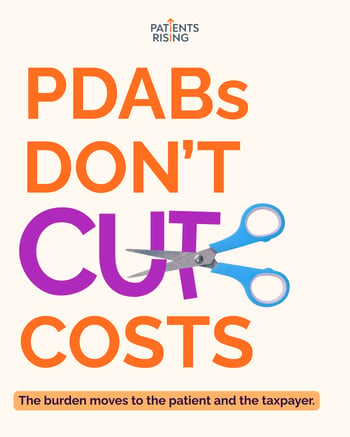 Virginia wouldn't be the first state to create a Prescription Drug Affordability Board. Maryland established one of the earliest PDABs in the country.
After more than five years of operation and high administrative costs at taxpayers' expense, Maryland's Board has publicly acknowledged it has not lowered the cost of a single drug for the state — much less delivered measurable savings to individual patients.
Several other states with PDAB legislation have seen their boards remain largely inactive or dormant for years. That's because there's a structural flaw in the PDAB model itself.
The Problem with SB 271
The bill is framed as an affordability measure. But its structure does not ensure patient benefit.
-
SB 271 does not require savings to be passed through to patients at the pharmacy counter.
-
SB 271 does not reduce copays, coinsurance, or deductibles.
-
SB 271 does not address rebate-driven pricing practices or pharmacy benefit manager spread pricing—the factors that most directly determine what patients actually pay.
Instead, SB 271 relies on regulatory price-setting mechanisms within the supply chain that may never translate into relief for patients.
The practical reach of SB 271 is also limited.
While the bill requires state-regulated health plans to comply with PDAB decisions, a substantial portion of Virginians receive coverage through employer-sponsored health plans governed by the federal Employee Retirement Income Security Act. These ERISA plans are not subject to state insurance regulation. As a result, a significant share of employer-sponsored coverage in Virginia would remain entirely outside the scope of SB 271, further limiting its impact.
Upper Payment Limits Create New Barriers
SB 271's reliance on Upper Payment Limits reveals another structural weakness. Manufacturers cannot be compelled to accept or honor a state-established price cap, meaning the policy does not directly regulate drug prices at the manufacturer level. Instead, it constrains reimbursement only within the state-regulated market.
Colorado's experience illustrates the consequences. The nation's first UPL applies only to state-regulated plans. Even under these conditions, the price cap does not require manufacturers to sell at the capped price. Rather, it places pressure on health plans and, most critically, on local pharmacies, which must operate within lower reimbursement limits while still acquiring and dispensing the drug.
This structure risks fragmenting the supply chain and shifting financial strain downstream. Pharmacies may be forced to renegotiate contracts, limit inventory, or decline to dispense certain medications—particularly high-cost or specialty drugs. For patients, this creates no guaranteed reduction in out-of-pocket costs and introduces real risks of reduced access, delayed treatment, or fewer participating pharmacies, especially in rural or underserved communities.
Affordability policies must be judged by a simple standard: Do they reliably lower what patients pay without compromising access to care?
Real Solutions Exist
Patients Rising strongly supports efforts to make medicines more affordable for Virginians. But policies that promise future savings without enforceable patient protections fall short.
Proven, patient-centered reforms offer more direct and reliable relief than the creation of another regulatory board. Point-of-sale rebate pass-throughs ensure that the discounts negotiated by pharmacy benefit managers actually reach patients at the counter. PBM transparency and accountability measures prevent the spread pricing practices that inflate costs. Clear price disclosure requirements allow patients to make informed decisions about their care.
These reforms deliver real, immediate, and guaranteed savings to patients while preserving access to the medicines they rely on.
What Virginia Patients Deserve
Virginia patients deserve more than the appearance of action. They deserve policies that demonstrably reduce what they pay without creating new barriers to treatment. They deserve legislation that protects both affordability and access. They deserve solutions that work in the real world, not just on paper.
SB 271 offers none of these guarantees. For these reasons, Patients Rising respectfully urges the Virginia General Assembly to reject SB 271 and instead pursue policies that deliver measurable, immediate relief to patients—policies that ensure every dollar of savings reaches the Virginians who need it most.
Because when it comes to healthcare, patients can't afford policies based on hope. They need policies backed by evidence, designed with their needs at the center, and proven to work.